
Vastu for the Main Door: Direction, Wood and Design
Vastu for the main door: the best directions and positions, what to do with a south-facing plot, size, threshold, opening direction and the right wood.

In this article
Vastu favours a main door on the north or east side of a house, placed towards the middle of that wall rather than in a corner. West is acceptable, and the south is generally avoided except at a few positions. For architects, the more useful part of Vastu is the detail that follows: which of the eight positions along a wall to use, which way the door opens, how high the threshold is, and what the door is made of. This guide covers each, separating what comes from the traditional texts from what modern practitioners have added.
What are Vastu and feng shui?
Vastu Shastra is India’s traditional system of architecture, set out in Sanskrit texts such as the Mayamata and Manasara. It plans buildings and rooms by direction, the five elements and the site. Feng shui is its Chinese counterpart: a tradition of arranging buildings, rooms and furniture to sit in harmony with their surroundings and the flow of qi.
The two grew up separately but run in parallel, and often arrive at similar practical rules, such as a solid wall behind the bed or a clear, welcoming entrance. We present both as cultural traditions, and say where advice comes from modern practitioners rather than the classical texts.
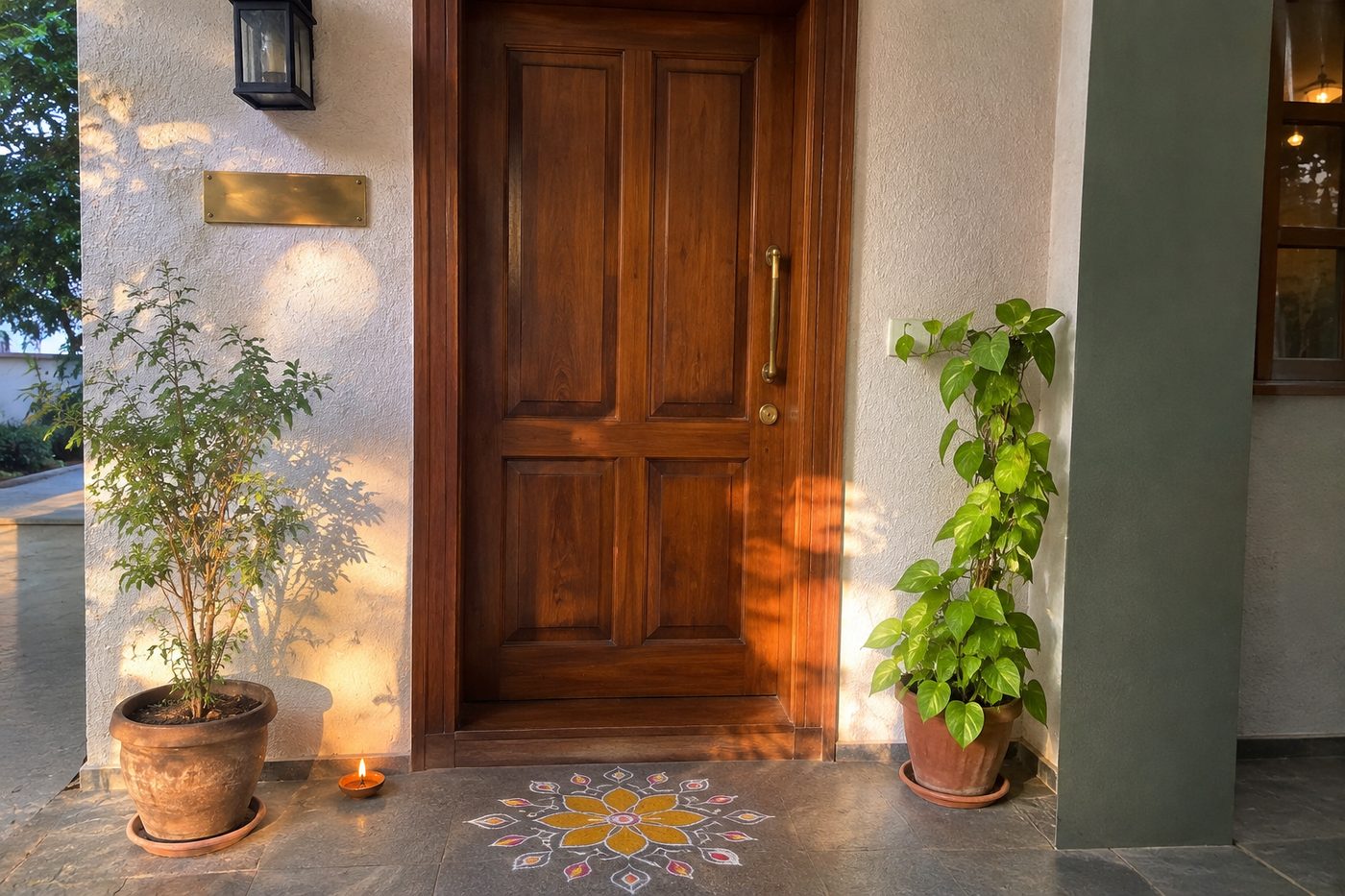
The short version:
- Best: north or east facing, towards the centre or the north-east half of the wall.
- Acceptable: west facing, near the centre of the wall.
- Usually avoided: corners, and most positions on the south wall.
- The main door should be the largest in the house, open inwards and clockwise, with a raised threshold and a solid wooden shutter.
Clients increasingly arrive with a Vastu consultant’s report already in hand, and the door position is usually its first line. It is cheaper to resolve at concept stage than after the structural grid is fixed. We make main doors and frames for architects across India, so we see how these rules play out on site; for the design side, read our companion guide to wooden main door designs.
Which direction should the main door face?
| House facing | Vastu view | Where on the wall |
|---|---|---|
| North | Favoured; associated with wealth and opportunity | Centre to north-east half; avoid the north-west corner |
| East | Favoured; associated with light, health and new beginnings | Centre to north-east half; avoid the south-east corner |
| West | Acceptable | Centre of the wall; avoid both corners |
| South | Generally avoided | A few positions towards the centre are accepted by some practitioners; consult before fixing |
Where the rules come from
Vastu’s building texts, such as the Mayamata and Manasara, plan a site on a grid called the Vastu Purusha Mandala, with deities assigned to each square around the edge. Each side has eight outer squares, called padas, and the door’s position is chosen by which pada it falls in. The texts describe some padas as auspicious and others not; modern practitioners have turned this into the familiar “north and east good, south bad” rule, and different schools number and rank the padas differently. Treat any single list with care, and agree one consultant’s scheme with the client early.
What if the plot faces south?
A south-facing plot does not have to mean a south-facing main door. Common solutions we see on drawings are:
- Setting the entrance on the east or west side of the building, with a path from the south gate.
- Placing the door in one of the more accepted south positions, towards the centre-east of the wall, as the client’s consultant advises.
- A covered entrance porch or foyer, so the first door faced on entering is on another axis.
Practitioners also suggest remedies such as a heavier solid wood door, a raised threshold and specific colours; these are traditions rather than structural requirements, so specify them only if the brief asks.
Send us the plan and the consultant’s requirements. We will make the door and frame to suit, and we respond within 24 hours.
Size, threshold and opening direction
The largest door in the house
The main door should be bigger than every internal door. In practice that means about 1000–1050 mm wide against 900 mm internal doors, and at least 2100 mm high.
Opens inwards, clockwise
Vastu prefers the door to swing into the house, clockwise as you enter. It is also the better security detail: the hinges are inside.
A raised threshold
A solid wooden or stone threshold (dehleez) marks the boundary. It also stops driven rain, so specify 20–25 mm above the finished floor with a drip on the outside.
Two shutters for wide openings
Double or one-and-a-half leaf doors are favoured for wide openings. See the sizes in our main door designs guide.
Which wood does Vastu recommend for a main door?
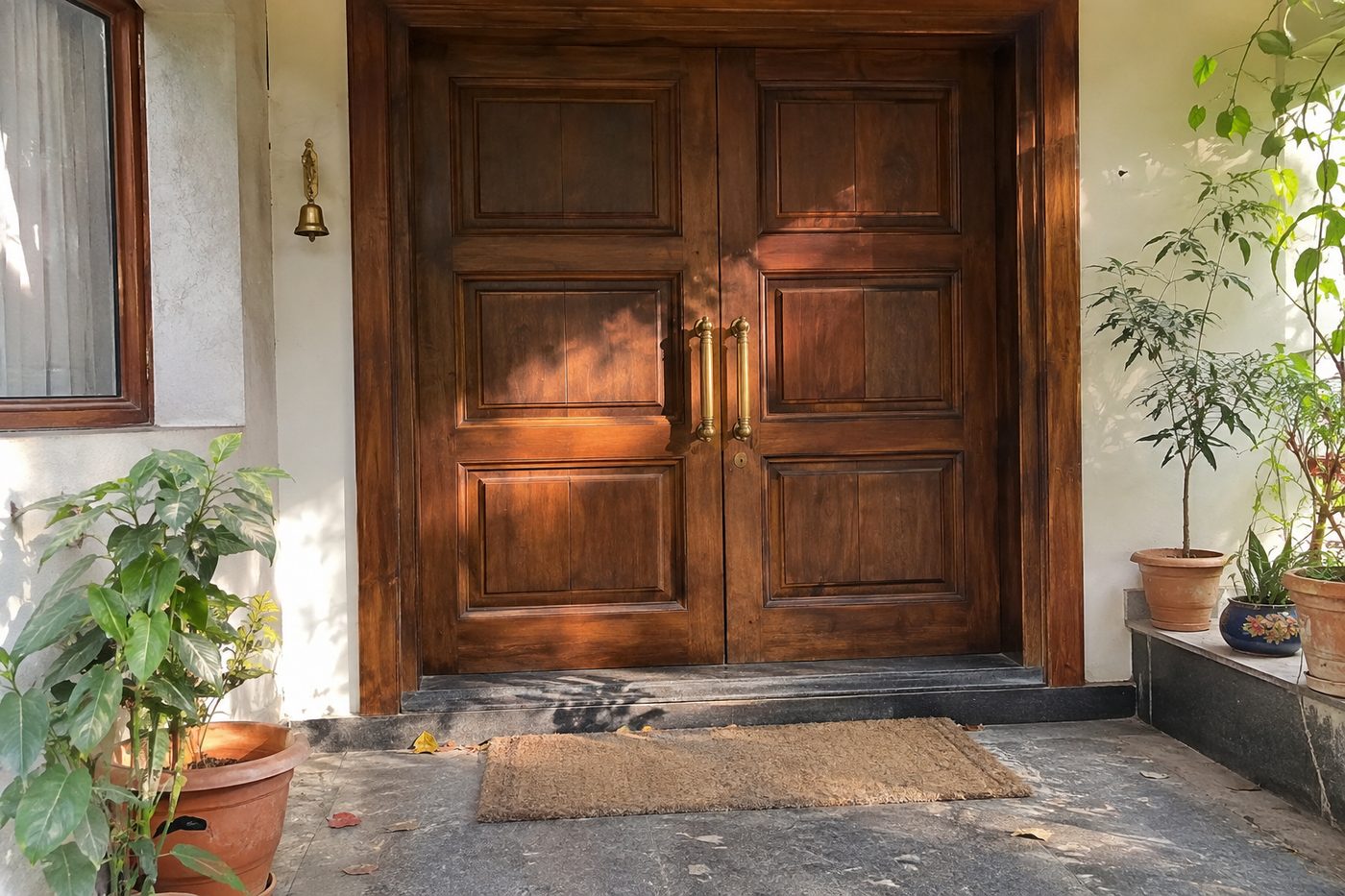
Practitioners consistently recommend wood over metal for the main door, and among woods the traditional choices are teak, sal and sheesham (Indian rosewood). The texts are less specific than modern advice suggests; the consistent theme is a solid, heavy door of good timber, not a particular species.
For export projects, use sapele, iroko or white oak rather than Burma teak, which cannot be sold into the US, UK or EU.
We hold these in our hardwood timber yard, and compare the two traditional Indian door woods in teak vs sheesham.
Colour, nameplate, lighting and what to avoid
- Keep the approach clear. No column, tree or pole directly in front of the door. It is also the clearer entrance in plan.
- Light it. A well-lit entrance is part of Vastu advice and of good design.
- Nameplate and decoration. Practitioners favour a nameplate in wood or metal, and auspicious symbols on or above the door.
- No door directly opposite. Avoid aligning the main door with the back door or another external door in a straight line.
- Maintain it. A door that creaks or sticks is considered inauspicious; it is also a door that needs re-hanging. A proper exterior finish keeps it moving freely.
The same logic continues inside: see bed direction as per Vastu, pooja room Vastu and kitchen direction as per Vastu. Our wooden mandirs and pooja units are made to fit the north-east.
Frequently asked questions
Which direction is best for the main door as per Vastu?
North or east, towards the centre or the north-east half of the wall. West is acceptable. South is generally avoided except at specific positions.
Can a south-facing door be fixed?
Often the entrance can be moved to the east or west side of the building, or placed in one of the accepted south positions. Practitioners also suggest remedies; agree them with the client’s consultant.
Should the main door open inward or outward?
Inward and clockwise, according to Vastu. It is also more secure, because the hinges are on the inside.
Which wood is good for a Vastu main door?
Teak, sal and sheesham are the traditional choices. The general principle is a solid, heavy wooden door rather than a particular species.
Should the main door have a threshold?
Yes. Vastu recommends a threshold, and a raised hardwood or stone threshold also keeps out rain and insects.
The bottom line
Put the main door on the north or east side, towards the centre or north-east, make it the largest door in the house, open inwards, and give it a solid wooden shutter and a raised threshold. Most of that is also good entrance design. Where the plot makes it hard, plan the approach and the foyer rather than forcing the door.
See our wooden doors, architraves and mouldings and millwork.
We make solid wood main doors and frames to drawings. We respond within 24 hours.
Keep reading in Vastu & Feng Shui
- Pooja Room Vastu: Mandir Direction and PlacementPooja room Vastu: where to place the mandir, which way to face, height, materials and how to plan…
- Kitchen Direction as per VastuKitchen direction as per Vastu: south-east or north-west, cooking facing east, sink and stove placement, and how to…
- Feng Shui Bedroom: Bed Placement, Wood and LayoutFeng shui bedroom rules explained: the commanding position, headboards, mirrors, balance and materials, and how they compare with…
- Bed Direction as per Vastu: Which Way to Sleep, and Where to Place the BedWhich way should your head point when you sleep? A furniture maker’s guide to the bed direction Vastu…
Shweta KhemkaWrites about interior design, architecture and Vastu for Kathwala, which makes solid wood furniture, doors, panelling and millwork to order for architects and homeowners. Questions? Get in touch.
Sources
- Vastu shastra: overview of texts including the Mayamata and Manasara
- School of Planning and Architecture, New Delhi: Vastu terminology (Vastu Purusha Mandala and padas)
- US Treasury OFAC: sanctions on Myanma Timber Enterprise, 21 April 2021