
Indian Rosewood: The Price of a Tree That Takes a Century to Grow
Why Indian rosewood (Dalbergia latifolia) is so expensive: slow growth, scarcity, regulation and a wood that is hard to work.

In this article
- The first look
- Which rosewood we mean
- Why Indian rosewood is so expensive
- How we handle Indian rosewood at Kathwala
- What Indian rosewood is used for
- Indian rosewood compared with the world’s other rosewoods
- Difference between Indian rosewood and sheesham
- Indian rosewood vs Burma teak
- Is Indian rosewood toxic?
- Caring for Indian rosewood furniture
- Frequently asked questions
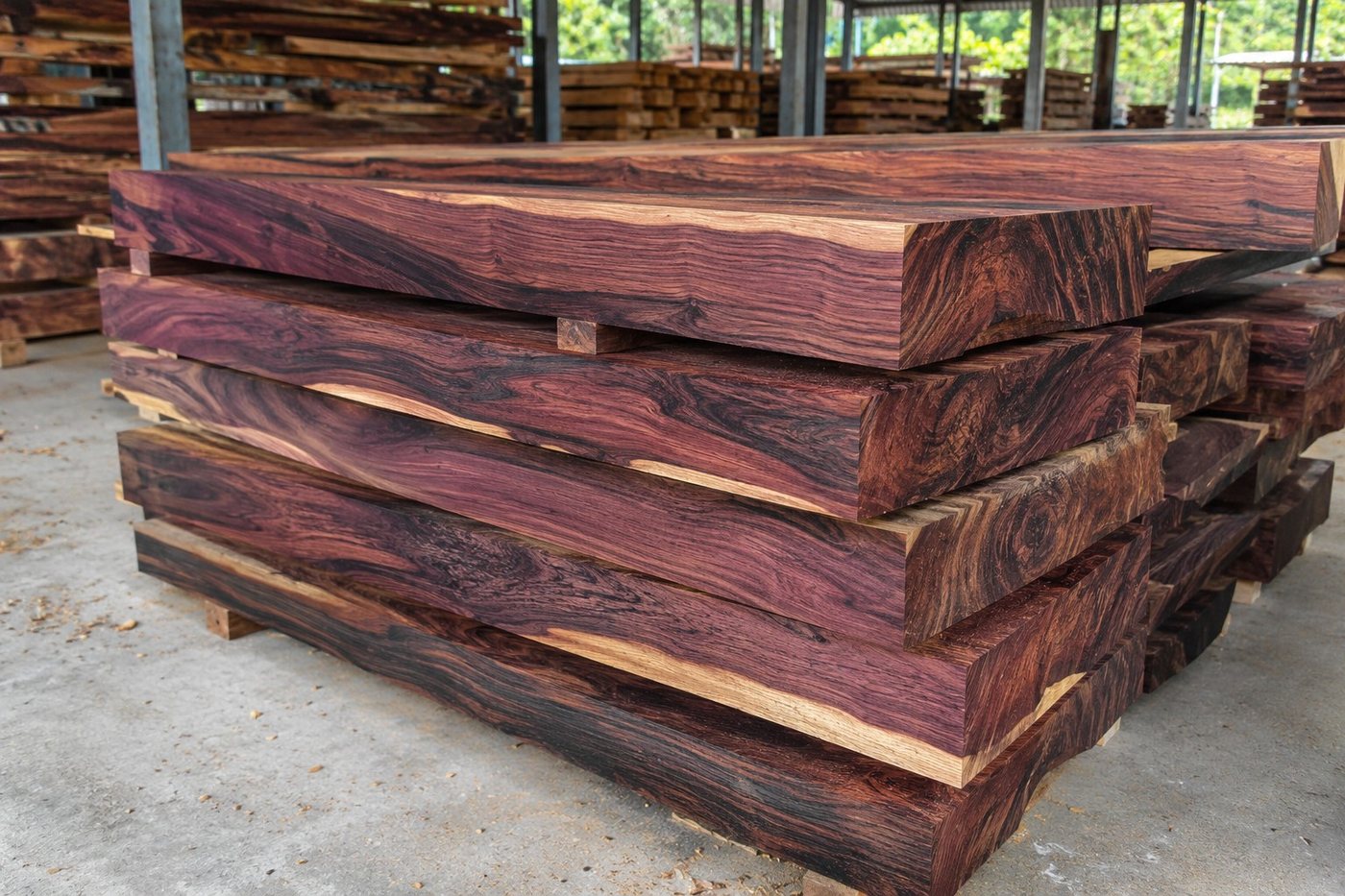
Indian rosewood is expensive because there is very little of it and it takes a very long time to grow. Dalbergia latifolia needs a century or more to grow large, figured heartwood, most old forest trees in India were cut decades ago, and felling is tightly controlled by the states where it grows. The wood itself is dense, oily and hard on tools, so it costs more to dry and machine, and more of each log is lost as waste. On top of that, every rosewood in the Dalbergia genus has been under CITES trade controls since 2017. What you pay for in Indian rosewood is scarcity, time and skill, in a wood that looks like nothing else.
The short version:
- We mean Indian rosewood, Dalbergia latifolia, also called East Indian rosewood, sitsal or sonokeling. It is not sheesham.
- Why it costs so much: slow growth (100–150 year rotations for high-grade timber), shrinking wild supply, state felling controls, CITES rules, a dense and oily wood that is slow to dry and hard on tools, and high waste.
- What it gives you: purple-brown wood with near-black streaks that deepens with age, Janka hardness of 2,350 lbf, very low movement and very high durability.
- Against sheesham: Indian rosewood is darker, heavier, harder and scarcer. Against Burma teak: harder and more figured, while teak is the better choice outdoors.
- Toxicity: the dust from cutting and sanding can irritate. A finished, sealed piece of furniture does not carry that risk.
- Everything we make in Indian rosewood is made to order.
The first look
Plane a board of Indian rosewood and the surface changes colour in front of you. Under the blade it is a warm, almost violet brown, crossed by dark lines like ink drawn through water. A faint sweet smell comes off the shavings. Run a hand across it and it feels cool and slightly waxy, because the wood carries its own oils. Leave it in the light for a few months and it settles into a deep chocolate-purple. Polish it and the figure seems to sit beneath a sheet of glass.
Generations of Indian makers have reached for it when a piece had to last: the bridal bed, the carved mandir, the main door, the sitar’s fingerboard. It is the wood people hand down. That reputation has a technical basis, and it also explains the price.
Which rosewood we mean
“Rosewood” is a trade name for many woods, several of them not related. This article is about Indian rosewood, Dalbergia latifolia, in the pea family (Fabaceae). It grows in the monsoon forests of southern and central India, especially the Western Ghats, and in plantations on Java in Indonesia, where it is called sonokeling. In the Indian trade it is also called sitsal, East Indian rosewood or Bombay blackwood. It is the rosewood shown throughout our wood species guide and the one we stock.
It is often confused with sheesham (Dalbergia sissoo), which is also sold as “Indian rosewood” or “North Indian rosewood”. They are cousins in the same genus, but they are different woods at different prices. There is a full comparison below.
Why Indian rosewood is so expensive
It grows very slowly
Kerala Forest Research Institute work reported in The Hindu found that an Indian rosewood tree takes about ten years to reach 6 metres in height and only 4–5 cm in diameter. Plantations aiming for high-grade timber work on rotations of 100 to 150 years, and a tree needs around 240 years to reach a trunk of 2.2–2.5 metres. The valuable part is the dark heartwood, which forms slowly in the centre of the trunk. The pale sapwood around it has little value.
Wild supply has shrunk
Indian rosewood is listed as Vulnerable on the IUCN Red List. Overcutting, poor natural regeneration and slow growth have thinned forest populations, and in districts such as Wayanad most forest trees were cut decades ago. Much of what remains stands on private land and in tea and coffee estates, where each tree needs permission to fell.
It is controlled at every step
States treat rosewood as a protected tree. Kerala, for example, bars cutting rosewood below 2.5 metres girth at breast height, and timber moves only under forest transit permits. Since 2 January 2017 every species of Dalbergia has been listed in CITES Appendix II, which controls international trade. India does not allow Indian rosewood to be exported as logs or sawn timber, only as veneer or finished products. Each layer adds cost and paperwork. For more on the regulations, read our guide to Indian rosewood export rules.
It is dense and oily
Indian rosewood weighs about 855 kg/m³ when dried, compared with about 655 kg/m³ for Burma teak. Its Janka hardness is 2,350 lbf, about 74% harder than white oak. The oils and mineral deposits that give it lustre and resistance to rot and insects also make it work differently from ordinary hardwoods.
Milling and labour are harder
The high density and oil content mean the wood needs specialised tools and careful seasoning. Chalky deposits in the wood dull cutting edges quickly. The grain is usually interlocked, so it can tear out when planed in the wrong direction. It dries very slowly and must be air-dried with the end grain sealed, or it splits. Oily surfaces can resist glue and some finishes unless they are prepared. All of this adds machine time, blade changes and rejected pieces, and those costs are built into every rosewood board and every rosewood piece of furniture.
More of each log is lost
Only the heartwood is wanted, logs are rarely straight and defect-free for long lengths, and boards with checks or sapwood are cut away. The usable yield from a rosewood log is lower than from a plantation timber, so the price of the good wood carries the cost of the waste.
No two boards are alike
The streaked, sometimes rippled figure that buyers pay for cannot be grown to order. Matching boards for a tabletop or a set of doors means sorting through stock for colour and figure, and the best-figured boards are priced accordingly.
Send us your drawing or a description. We make every rosewood piece to order and respond within 24 hours.
How we handle Indian rosewood at Kathwala
Rosewood punishes a workshop that rushes it. We have worked with hardwoods since 1985, and our process is built around what a dense, oily wood needs.
Cutting
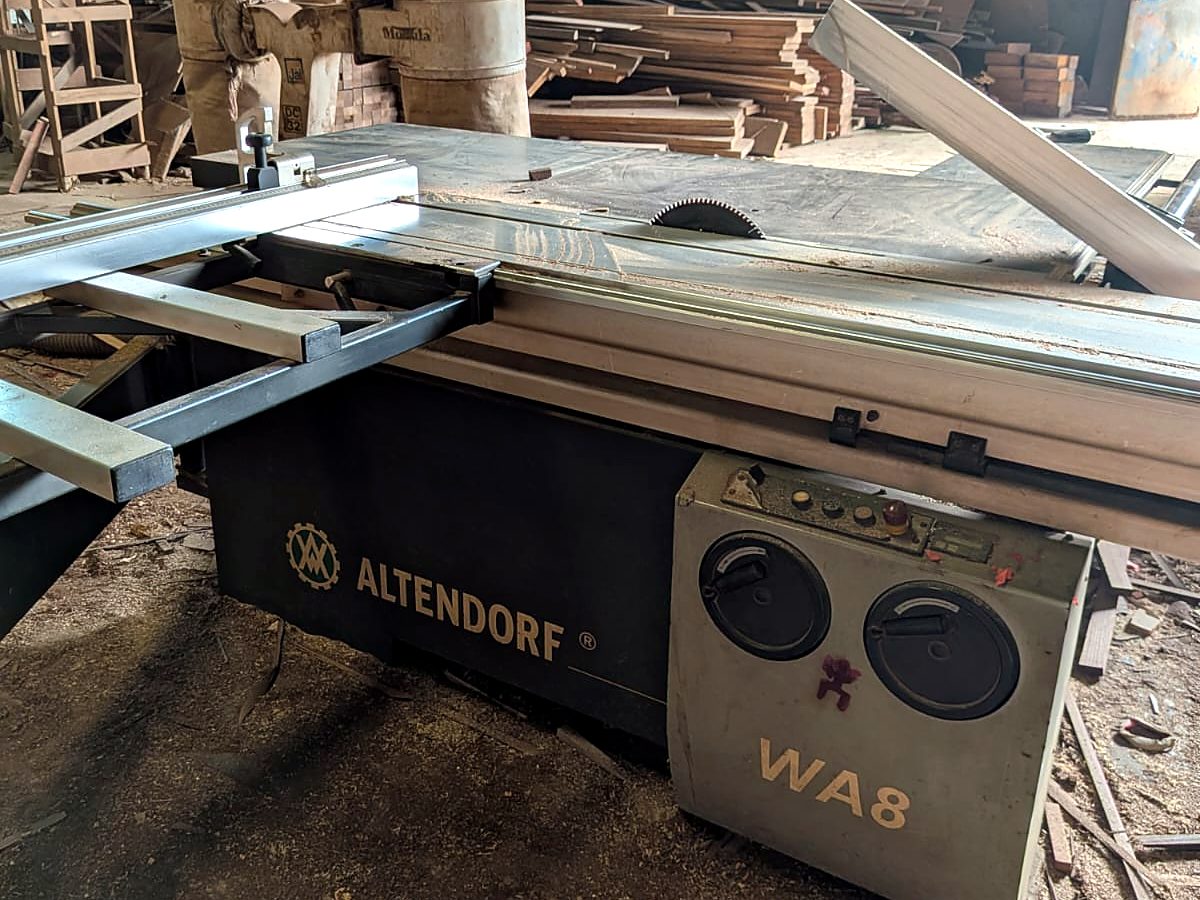
We cut rosewood on an Altendorf WA8 sliding panel saw, a German precision saw, with tungsten carbide-tipped (TCT) blades. Carbide holds its edge far longer than steel against rosewood’s mineral deposits. We run a slower feed so the cut stays clean and the interlocked grain does not burn or tear.
Joinery
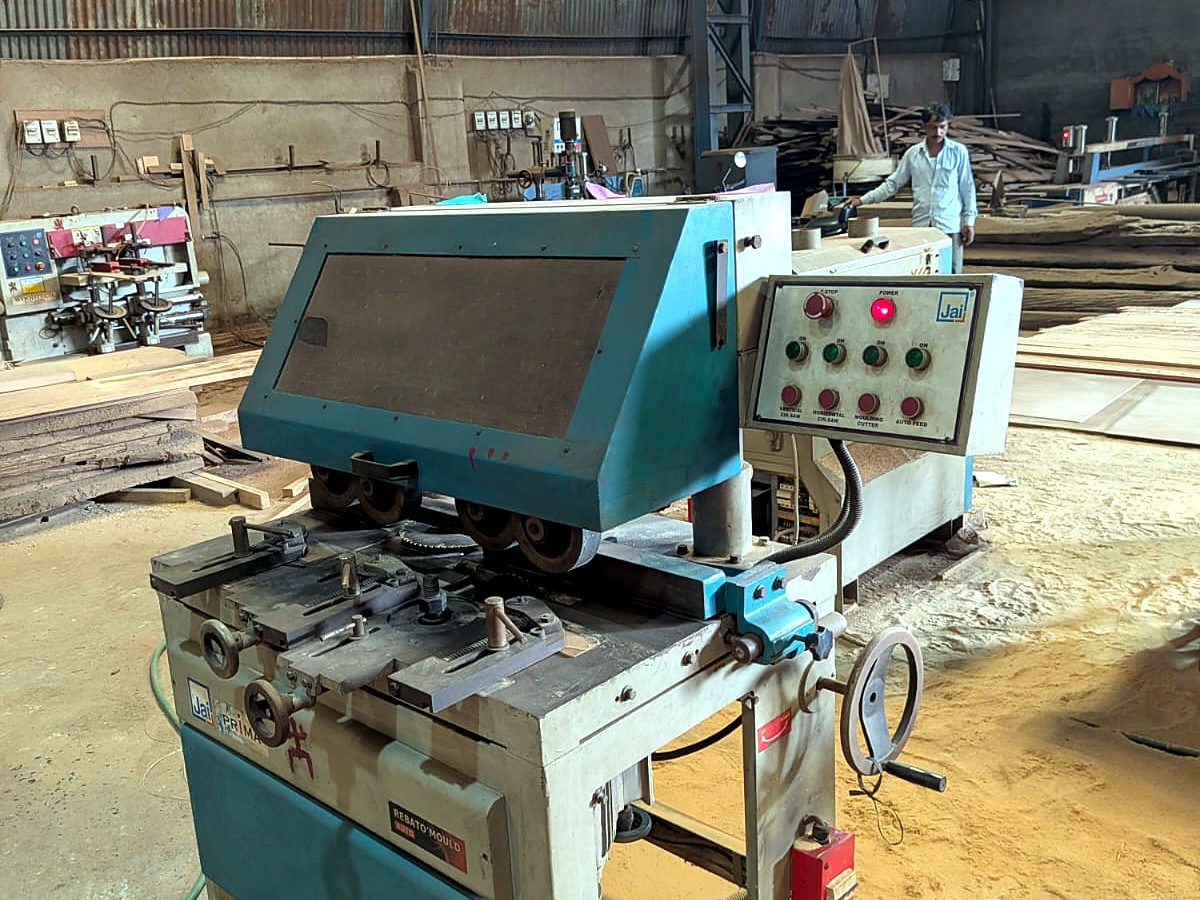
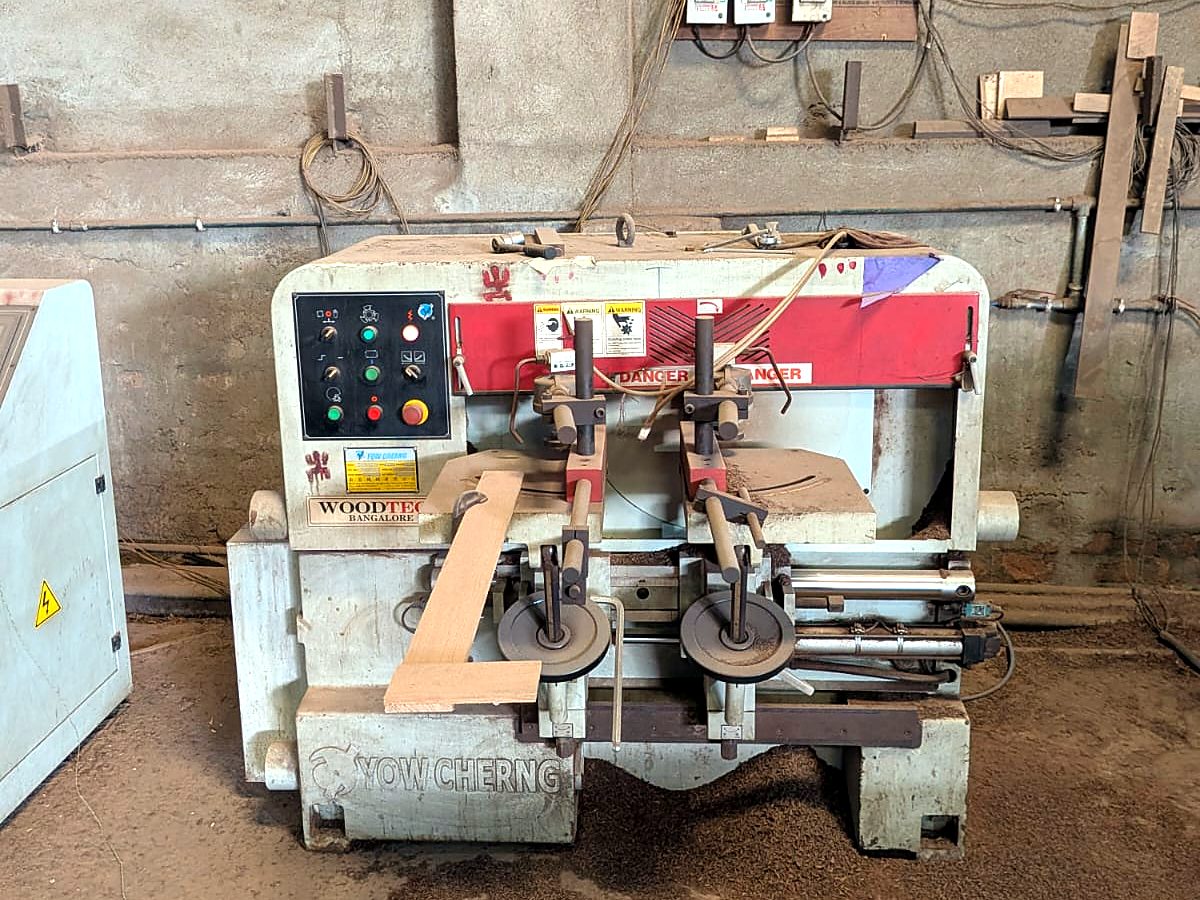
Tenons for frames, doors and furniture are cut on a double-end tenoning machine, so both ends of a rail are cut in one setting and joints fit tight in a wood that does not forgive loose work. Read more about the joints we use.
Drying. Rosewood is air-dried slowly with the end grain sealed in wax, then left to settle before machining. Rushing it causes end checks and hidden stress that shows up months later as a split. Finishing. We wipe the surface to remove surface oil before gluing and finishing, and choose the finish for the piece; our guide to wood polish types explains the options. Waste. Offcuts too small for furniture go into smaller pieces such as solid wood photo frames and serving boards, which helps keep the cost of the main piece down.
What Indian rosewood is used for
It is prized for heirloom furniture, architectural veneers and musical instruments, because of its rich acoustic resonance, natural polish and distinctive grain. Luthiers use it for guitar backs, sides and fingerboards, and Indian instrument makers use it for sitar fingerboards and fittings and for tabla shells. It also turns well, so it is used for handles, carvings and small boxes.
At Kathwala we make the following in Indian rosewood. Everything is made bespoke, to order, to your drawings or one of our designs:
Flooring
Wood flooring and solid hardwood flooring for rooms where a dark, hard-wearing floor is wanted. Rosewood’s hardness resists dents better than oak.Panelling
Wall panels and cladding and wood wall panels, from plain boards to profiled and carved panels.Children’s furniture
children’s furniture, including cots and cribs, kids’ beds and study tables, built to be handed down.Bedroom furniture
bedroom furniture: beds, wardrobes, bedside tables, chests of drawers and dressing tables.Living room furniture
living room furniture: console tables and TV units, coffee tables, bookshelves and pooja units.Kitchen and dining
kitchen and dining furniture: dining tables, chairs and benches, kitchen islands and serving boards.We also supply veneers and hardwood timber for makers who do their own work. Contact us for current pricing and availability.
Indian rosewood compared with the world’s other rosewoods
True rosewoods belong to the genus Dalbergia. Several other woods are sold as “rosewood” without being related. Here is how Indian rosewood compares.
| Wood | Botanical name | Look | Density / hardness | Status and availability | Typical use |
|---|---|---|---|---|---|
| Indian rosewood | Dalbergia latifolia | Purple-brown with near-black streaks, darkens with age | 855 kg/m³ / 2,350 lbf | CITES Appendix II; IUCN Vulnerable; legal supply limited | Heirloom furniture, veneer, guitars, sitars |
| Brazilian rosewood | Dalbergia nigra | Chocolate to reddish brown with dramatic dark streaks | 835 kg/m³ / 2,790 lbf | CITES Appendix I since 1992; almost only old reclaimed stock | Vintage guitars, antique furniture |
| Honduran rosewood | Dalbergia stevensonii | Light to purplish brown, mauve tones | 1,025 kg/m³ / 2,200 lbf | CITES Appendix II | Xylophone and marimba bars, guitars |
| Cocobolo | Dalbergia retusa | Orange, red and brown with black streaks | 1,095 kg/m³ / 2,960 lbf | CITES Appendix II; strong sensitiser | Knife handles, turnings, small objects |
| Madagascar rosewoods | Dalbergia spp. | Deep red to purple | Varies by species | Madagascar has banned exports; CITES trade controls | Not legally available |
| Siamese and Burmese rosewoods (“hongmu”) | D. cochinchinensis, D. oliveri | Reddish to deep purple-brown | Very dense | CITES Appendix II; heavily trafficked for Chinese furniture | Classical Chinese furniture |
| African blackwood | Dalbergia melanoxylon | Near-black | Among the densest woods | CITES Appendix II | Clarinets, oboes, bagpipes |
| Sheesham (North Indian rosewood) | Dalbergia sissoo | Golden to mid brown with darker streaks | About 750–800 kg/m³ | CITES Appendix II; widely planted in India | Everyday solid wood furniture |
| “African rosewood”, kosso | Pterocarpus erinaceus | Reddish brown | Dense | Not a true rosewood; CITES Appendix II | Furniture (often illegally logged) |
| Padauk | Pterocarpus soyauxii | Bright orange-red, browns with age | Dense | Not a true rosewood | Furniture, turnery |
Brazilian rosewood is the most famous of them, and the reason so many old guitars are valued as they are. Since it went into Appendix I, new Brazilian rosewood has been all but impossible to trade, and Indian rosewood became the rosewood most instrument makers and furniture makers use instead. It is the best balance of looks, stability and legal availability among the true rosewoods.
Difference between Indian rosewood and sheesham
This is the question we are asked most. Both are Indian, both are Dalbergia, and both are sold as “rosewood”, so the confusion is understandable. They are not the same wood, and they should not be priced the same.
| Indian rosewood | Sheesham | |
|---|---|---|
| Botanical name | Dalbergia latifolia | Dalbergia sissoo |
| Other names | East Indian rosewood, sitsal, sonokeling, Bombay blackwood | Shisham, North Indian rosewood, tahli |
| Where it grows | Monsoon forests of southern and central India; Java plantations | North India and the Himalayan foothills; widely planted on farms, roadsides and canal banks |
| Colour | Purple-brown to deep violet with near-black streaks; darkens to chocolate-purple | Golden to medium brown with darker brown streaks; darkens to a warm brown |
| Grain and figure | Interlocked; dramatic streaked figure | Interlocked; figure usually milder |
| Density (dried) | About 855 kg/m³ | About 750–800 kg/m³ |
| Hardness | Very hard (2,350 lbf Janka) | Hard, noticeably less than Indian rosewood |
| Scent when cut | Sweet, faintly rose-like | Mild |
| Oil and lustre | Oily; takes a deep, glassy polish | Less oily; polishes well |
| Supply | Scarce, IUCN Vulnerable, strict felling controls | Plentiful; grown as a farm tree |
| Price | Much higher | Moderate |
| CITES | Appendix II | Appendix II |
| Best for | Heirloom furniture, doors, flooring, panelling, instruments | Everyday solid wood furniture and cabinetry |
How to tell them apart
- Colour of fresh-cut wood. Indian rosewood has a purple or violet cast; sheesham is golden to brown. Ask to see a freshly planed or sanded patch, since polish and stain can hide the difference.
- Weight. Indian rosewood is about 10% heavier. Two same-size boards side by side make it obvious.
- Streaks. Indian rosewood’s dark streaks are near-black and sharply drawn. Sheesham’s are browner and softer.
- Smell. Sanded Indian rosewood has a sweet scent; sheesham is milder.
- Paperwork. Ask for the botanical name on the invoice. A seller confident it is Dalbergia latifolia will write it down.
Sheesham is an excellent wood in its own right and often the sensible choice for everyday furniture. Our teak vs sheesham guide covers it in detail. Just make sure that when you pay for Indian rosewood, you get it.
Indian rosewood vs Burma teak
Burma teak is the other wood Indian families have trusted for generations, especially for main doors. The two suit different jobs.
| Indian rosewood | Burma teak | |
|---|---|---|
| Botanical name | Dalbergia latifolia | Tectona grandis (natural-forest teak from Myanmar) |
| Colour | Purple-brown with near-black streaks | Golden brown, ageing to a warm honey-brown |
| Density (dried) | About 855 kg/m³ | About 655 kg/m³ |
| Janka hardness | 2,350 lbf | 1,070 lbf |
| Volumetric shrinkage | 8.6% | 7.2% |
| Durability | Very durable | Very durable; the benchmark for decay resistance |
| Outdoors | Durable, but rarely used outside because of cost | The best choice for decks, boats and outdoor furniture |
| Working | Hard on tools; interlocked grain; slow to dry | Easy to work, though its silica dulls edges |
| Legal status | CITES Appendix II | Not in CITES; sanctions mean it cannot be exported to the US, UK or EU |
| Best for | Statement furniture, flooring, panelling, instruments | Main doors, windows, outdoor and bathroom furniture |
Choose Indian rosewood when you want a dark, dramatic, very hard surface indoors: a dining table, a bed, a floor or a panelled room. Choose Burma teak or plantation teak for a main door facing weather, for outdoor furniture, or for bathrooms. Many of our clients use both in the same house.
Is Indian rosewood toxic?
Indian rosewood is a known sensitiser, like many tropical hardwoods including teak. When it is sawn, planed and sanded, the fine dust can irritate the skin, eyes and airways of some people, and woodworkers can become more sensitive with repeated exposure. That is a workshop issue, handled with dust extraction and protective equipment while the wood is being cut.
Finished furniture is different. Once a piece is sanded, sealed and polished, there is no dust, and the finish covers the surface. Living with, touching or eating at a finished Indian rosewood piece does not carry the risks that apply to cutting it. If you ever sand or refinish a rosewood piece yourself, do it outdoors or with a dust mask.
Caring for Indian rosewood furniture
- Dust with a soft, dry cloth; avoid silicone sprays, which build up on the surface.
- Keep pieces out of strong direct sunlight, which changes the colour over time.
- Use coasters and mats; PU finishes resist water and heat best.
- Indian rosewood moves very little, but keep it away from heaters and air-conditioner outlets.
- Re-oil oiled finishes once or twice a year; polished finishes need only a wax now and then.
Frequently asked questions
Why is Indian rosewood more expensive than sheesham?
Indian rosewood grows far more slowly, is scarce in the wild and tightly controlled, is denser and harder to work, and has a darker, more dramatic figure. Sheesham is grown widely as a farm tree and is easier to machine.
Is Indian rosewood the same as sheesham?
No. Indian rosewood is Dalbergia latifolia; sheesham is Dalbergia sissoo. They are related, but differ in colour, weight, hardness, supply and price.
Is Indian rosewood harder than teak?
Yes. Its Janka hardness is 2,350 lbf against about 1,070 lbf for Burma teak, so it resists dents more than twice as well.
Does Indian rosewood darken with age?
Yes. It deepens from a purple-brown to a dark chocolate-purple over months and years.
Is it legal to buy Indian rosewood furniture?
Yes, provided the wood came from a legal source. Within India it moves under forest transit rules; across borders, CITES applies. See our guide to Indian rosewood export rules.
How much does Indian rosewood cost?
Prices depend on size, grade, figure and quantity, and they change often, so we do not publish them. Contact us with what you need and we will give you a current quote.
Can Indian rosewood be used for flooring?
Yes. Its hardness and low movement make it an excellent, if luxurious, flooring wood. We make rosewood flooring to order.
Read next: our guide to Indian rosewood export rules, our Indian rosewood species profile, and our guides to teak vs sheesham and Burma teak.
Contact us on +91 98318 28922 (also on WhatsApp), +91 33 2259 1296 or info@kathwala.com.
Every rosewood piece we make is made to order. Send us your drawing, sizes or an idea, and we respond within 24 hours.
Keep reading in Wood & Materials
- Types of Wood Grain: Grain, Texture and Figure ExplainedWood grain explained: growth rings, pores and rays, flat-sawn vs quartersawn, straight, spiral and interlocked grain, texture, figure…
- EU Green Claims Rules: What “Eco-Friendly” Wood and Furniture Can Still SayEmpCo, the EU’s green claims rules, has applied since 27 September 2026. What wood and furniture listings can…
- WPC Board: Price, Uses, and WPC vs PlywoodWhat WPC board is, where it beats plywood and where it doesn’t, typical prices, and how to work…
- Teak Wood vs Sheesham Wood: Price, Strength and LooksTeak vs sheesham: density, durability, stability, looks and price, and which to choose for doors, outdoor and indoor…
Sanjeev KhemkaWrites about timber, woodworking and trade for Kathwala, which supplies hardwood timber, plywood and panels and makes solid wood furniture and millwork to order. Questions? Get in touch.
Sources
- The Wood Database: East Indian rosewood (Dalbergia latifolia)
- The Wood Database: Brazilian rosewood
- The Wood Database: Honduran rosewood
- The Wood Database: cocobolo
- The Wood Database: teak
- The Hindu: why rosewood is in the cross hairs (growth rates, Kerala felling rules)
- Dalbergia latifolia: IUCN status and range
- Tamil Nadu Rosewood Conservation Act lapses, September 2025
- CITES SC78 Doc. 77: annotation #15 for Dalbergia, February 2025
- Taylor Guitars: CITES and rosewood