
Types of Wood Grain: Grain, Texture and Figure Explained
Wood grain explained: growth rings, pores and rays, flat-sawn vs quartersawn, straight, spiral and interlocked grain, texture, figure types and knots, with a grain guide to 34 woods.

In this article
- Grain, texture and figure: three different things
- Where grain comes from: inside the tree
- How sawing changes the grain
- Grain direction: straight, spiral, interlocked and wavy
- Texture: fine, medium and coarse
- Types of figure
- Knots
- What grain means for strength, stability and finishing
- Matching grain in design
- Grain guide to every wood we stock
- How to buy wood by grain
- Frequently asked questions
Wood grain is the pattern of fibres and growth rings you see on the surface of a board. It is shaped by three things: how the tree grew (its growth rings, pores and rays), the direction the fibres run (straight, spiral, interlocked or wavy), and how the log was sawn (flat-sawn, rift-sawn or quartersawn). Woodworkers use three related words: grain for the direction and spacing of the fibres, texture for the size of the pores, and figure for the decorative pattern, such as the cathedral arches of oak, the ribbon stripe of Sapele or the birdseye of maple. This guide explains each one, with a grain profile for every wood we stock.
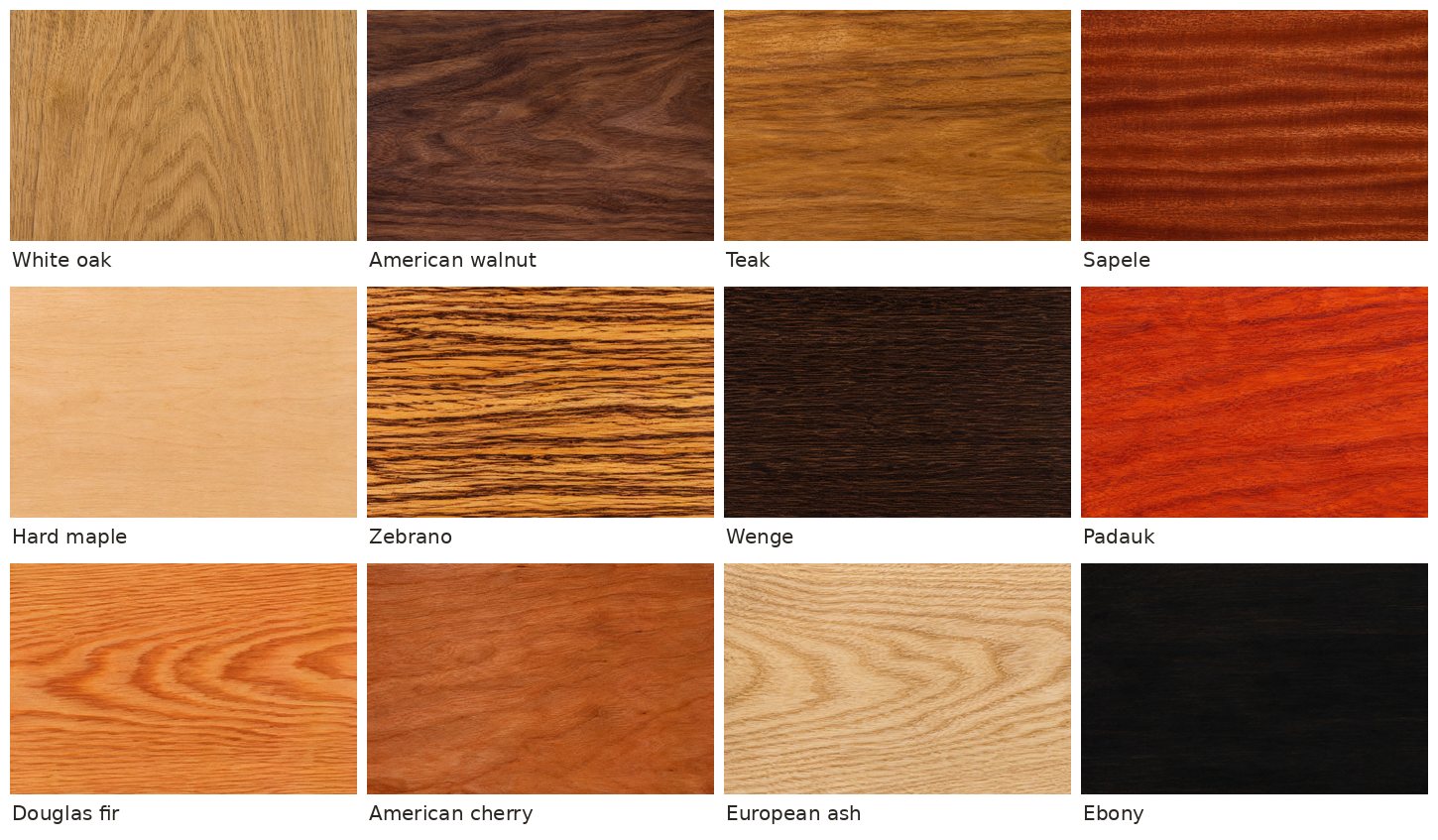
The short version:
- Grain, texture and figure are different things. Grain is fibre direction and ring spacing, texture is pore size, figure is the visible pattern.
- Growth rings make most of the pattern. Pale earlywood and denser latewood alternate every season; the stronger the contrast, the bolder the grain.
- The cut decides the look. Flat-sawn boards show arches, quartersawn boards show straight stripes and ray fleck, rift-sawn boards show quiet straight lines.
- Interlocked grain gives the ribbon stripe of sapele and mahogany, and also makes those woods tear out when planed.
- Figure such as curl, birdseye, quilt, burl and crotch comes from disturbed growth, and is rare and priced accordingly.
- Knots are where branches grew; tight knots are sound, loose knots can fall out.
This is written for architects, interior designers, contractors and furniture makers who specify wood by appearance as well as performance. It draws on the USDA Forest Products Laboratory Wood Handbook and the species data on our wood species guide.
Grain, texture and figure: three different things
Grain
The direction the wood fibres run along the board (straight, spiral, interlocked, wavy), and the spacing of the growth rings (fine-grained or coarse-grained). The Wood Handbook uses the word in both senses.
Texture
The size and distribution of the cells, mainly the pores. Fine texture (maple, beech, cherry) feels smooth and finishes glassy. Coarse texture (oak, ash, wenge) shows open pores that may need filling.
Figure
The pattern you see on a finished surface: arches, stripes, flecks, ripples, eyes or swirls. Figure is what grain, texture, colour and the sawing angle add up to.
So a board of American Walnut can be described as straight-grained (fibre direction), medium-textured (pore size) and curly (figure), all at once.
Where grain comes from: inside the tree
Growth rings: earlywood and latewood
Each growing season a tree adds a layer of new wood under the bark. In spring it grows fast and makes earlywood, with larger, thinner-walled cells that look paler. Later in the season growth slows and it makes latewood, with smaller, thick-walled cells that look darker and denser. The pair makes one growth ring. Where the switch is abrupt, as in Southern Yellow Pine (SYP) and Douglas Fir, the grain is bold and stripy. Where it is gradual, as in Spruce or maple, the grain is soft and quiet. Tropical trees that grow without a winter often have faint rings or none, which is why many tropical woods look even.
Pores: ring-porous, semi-ring-porous and diffuse-porous
Hardwoods carry water through vessels, which show on a cut surface as pores. How the pores are arranged inside each ring is one of the biggest influences on how a wood looks and finishes.
| Pore pattern | What happens in the ring | How the grain looks | Our woods |
|---|---|---|---|
| Ring-porous | Large pores form a band in the earlywood; the latewood is dense with small pores | Bold, high-contrast grain; coarse, uneven texture | White Oak, Red Oak, European Ash, White Ash, Teak |
| Semi-ring-porous | Pores start large and get gradually smaller through the ring | Softer contrast; medium texture | American Walnut, American Cherry |
| Diffuse-porous | Pores of similar size spread evenly through the ring | Even, uniform look; fine to coarse texture depending on pore size | Maple, Sycamore, beech, Mahogany, Sapele, Iroko, Merbau, Padauk, Indian Rosewood, Ebony and most tropical hardwoods |
| Softwood (no vessels) | Water moves through tracheids, over 90% of the wood; some species have resin canals | Pattern comes from earlywood and latewood contrast alone | Douglas Fir, Southern Yellow Pine (SYP), Hemlock, Spruce, SPF |
Rays
Rays are ribbons of cells that run from the centre of the tree outwards, carrying food sideways. On most woods they are too small to notice. On oak, beech and Sycamore they are big enough to show as flecks when the board is quartersawn. White oak’s rays can be more than 25 mm tall on the face, which is where the “tiger” or “silver” figure of quartersawn oak comes from.
Heartwood and sapwood
The outer, living band of the trunk is sapwood, usually pale. The inner heartwood is darker because it stores extractives, which give woods such as walnut, cherry and Indian Rosewood their colour. A board that includes both shows a sharp colour change along one edge. In a few woods, such as Spruce and Hemlock, the two look almost the same.
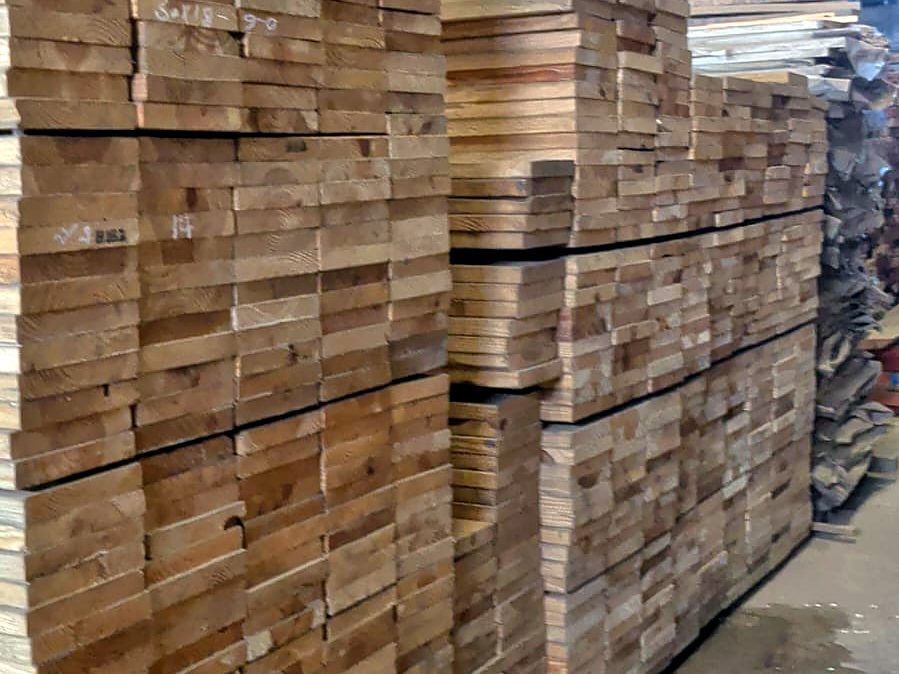
Read the end grain first
The end of a board is a cross-section of the log. Curved rings running across the end mean the board is flat-sawn and will show arches. Rings running from face to face, close to vertical, mean it is quartersawn and will show straight stripes. Rings at roughly 45° mean rift-sawn. This takes two seconds and tells you how the face will look and how the board will move.
How sawing changes the grain
The same log can produce boards that look completely different, depending on the angle between the saw cut and the growth rings.
| Cut | Ring angle to the face | What the face shows | Movement | Use it for |
|---|---|---|---|---|
| Flat-sawn (plain-sawn) | 0–45° | Cathedral arches and flame shapes in the middle of the board, straight lines at the edges | Moves most in width; can cup | Most furniture, tabletops, panelling where a lively grain is wanted |
| Rift-sawn | about 30–60° | Straight, even lines with little or no ray fleck | Stable | Modern cabinetry, table legs (straight grain on all four faces), stair parts |
| Quartersawn | 45–90° | Straight stripes; ray fleck in oak, beech and sycamore; ribbon stripe in interlocked woods | Moves least in width; cups and checks less | Floors, doors, wide panels, Arts and Crafts furniture |
The Wood Handbook notes that quartersawn boards shrink and swell less in width, cup and surface-check less, and hold paint better in some species, while flat-sawn boards are cheaper, shrink less in thickness and are less prone to collapse in drying. For wood flooring and doors, quartersawn or rift-sawn stock is worth asking for; for a dining table, flat-sawn usually looks warmer.
Veneers and plywood
Veneer is cut in similar ways. Rotary-cut veneer is peeled from a turning log like paper from a roll, which gives the wide, wild grain seen on most plywood faces. Flat-sliced (crown-cut) veneer looks like flat-sawn timber, and quarter-sliced veneer gives straight stripes. Ask which cut a veneer is when you specify it, because it changes the look more than the species name does.
Tell us the look you want and where it is going. We will suggest a species and cut, and send photos of the actual stock. We respond within 24 hours.
Grain direction: straight, spiral, interlocked and wavy
Straight grain
Fibres run parallel to the length of the board. It is the strongest and easiest to work, and gives a calm, even look. Maple, beech, Spruce and most Teak are straight-grained.
Spiral grain
Fibres wind around the trunk like a barber’s pole. Boards cut from such a log have fibres running at an angle to the edge, which reduces strength and makes them twist as they dry. It is hard to see on the face, but shows as splits running at an angle.
Interlocked grain
The spiral changes direction every few years, so successive layers slope in alternate directions. When quartersawn, light reflects differently off each layer, producing the shimmering ribbon stripe of Sapele, Mahogany, Iroko and meranti. The downside is tear-out: whichever way you plane, half the stripes are against the grain.
Two more terms matter on the drawing board. Cross grain or slope of grain means the fibres run at an angle to the edge of the board; beyond a small angle it weakens a board in bending, which is why structural grading limits it. Short grain is a thin section where fibres run across rather than along a part, such as a curved chair arm cut from one board, and it snaps easily.
Texture: fine, medium and coarse
| Texture | What you see and feel | Finishing | Examples |
|---|---|---|---|
| Fine, even | Pores barely visible; smooth to the touch | Takes a glassy finish easily; some species blotch when stained | Maple, Sycamore, beech, cherry, Ebony |
| Medium | Pores visible but small | A sealer coat usually gives a smooth finish | Walnut, Purpleheart, Indian Rosewood |
| Coarse, open | Pores clearly visible; you can feel them | Pores show through a thin finish; use a grain filler for a mirror finish, or leave them open for an oiled look | Oak, ash, Wenge, Teak, Padauk, Merbau |
Uneven texture, as in ring-porous oak and ash, means coarse earlywood alternates with fine latewood, so stain soaks in more in some bands than others and the grain looks stronger after staining. Our guide to wood polish types explains which finishes suit open-pored woods.
Types of figure
Figure is what makes one board of the same species worth several times another. Some figure comes from the way the log is cut; the rarer kinds come from disturbed growth, and appear in only a small share of trees.
| Figure | What it looks like | What causes it | Where you see it |
|---|---|---|---|
| Cathedral (flame) | Nested arches or flame shapes in the middle of a flat-sawn board | Cutting tangentially through the growth rings | Oak, ash, Douglas Fir, pine |
| Ray fleck (tiger, silver figure) | Shiny flakes or bars crossing the stripes | Large rays exposed on a quartersawn face | Oak, beech, Sycamore |
| Ribbon stripe | Alternating light and dark stripes that swap as you move | Interlocked grain on a quartersawn face | Sapele, Mahogany, Iroko, meranti, balau |
| Curly (tiger stripe) | Bars of light and shade across the board | Wavy fibres on a flat-sawn face | Maple, cherry, walnut, ash |
| Fiddleback (ripple) | Fine, close, even ripples across the grain | Wavy fibres on a quartersawn face | Sycamore, maple, Sapele, Mahogany |
| Birdseye | Small round “eyes” scattered over the board | Local distortions in growth; most common in northern hard maple | Hard Maple |
| Quilted and blister | Bulging, pillow-like or blister-like shapes | Undulating growth rings, seen on flat-sawn faces | Maple, sapele |
| Pommele and mottle | Small rounded blisters or blotchy, wrinkled patches | Irregular grain in some logs | Sapele, Mahogany |
| Crotch (feather) | A plume or feather shape | Wood from the fork where a trunk divides | Walnut, Mahogany |
| Burl (burr) | Tight swirls and clusters of small dark knots | A growth on the trunk where buds divide repeatedly | Walnut, oak, maple veneers |
| Zebra stripes | Bold, regular dark stripes | Contrasting growth layers cut on the quarter | Zebrano |
| Parenchyma banding | Fine, even light and dark pinstripes | Bands of storage cells, not growth rings | Wenge |
| Streaks and deposits | Dark streaks, yellow specks or gum flecks | Extractives and minerals laid down in the heartwood | Indian Rosewood streaks, Merbau yellow deposits, cherry gum flecks, olive ash |
| Bear claw | Short claw-mark ripples | Seen occasionally on vertical-grain spruce | Spruce |
| Spalting | Dark zone lines and bleached patches | Fungus in the early stages of decay; dried and stabilised before use | Beech, maple (specialty pieces) |
Two boards of the same species can look less alike than two different species. Specify the cut and the figure, not just the wood.
Knots
A knot is the base of a branch, enclosed as the trunk grows around it. While the branch is alive its wood is grown into the trunk, which makes an intergrown or tight knot that stays put. When the branch dies, the trunk keeps growing around the dead stub, which makes an encased or loose knot, often ringed with bark, that can fall out. Once the stub is buried, the tree lays down clear wood over it.
| Knot | What it is | What to do |
|---|---|---|
| Sound, tight (live) knot | Grown into the surrounding wood | Fine in character grades; adds a rustic look |
| Loose (dead) knot | Surrounded by bark or a gap | Cut out, or fill with epoxy for a rustic finish |
| Pin knot | Under about 6 mm | Accepted in most grades, common in plantation teak |
| Spike knot | A branch cut lengthwise, showing as a long streak | Weakens boards; avoid in structural parts |
| Knot cluster | Several knots together, often with swirling grain | Decorative in panelling; avoid in rails and legs |
Softwoods such as SPF, Spruce and pine are knottier than most hardwoods, because conifers keep their lower branches longer. Grading rules limit knot size and position; clear and select grades have few or none. Grain bends around every knot, so the wood next to a knot is weaker and harder to plane cleanly.
What grain means for strength, stability and finishing
Strength
Wood is strongest along the fibres. Steep slope of grain, short grain, spiral grain and knots all reduce strength, which is why structural timber is graded on them. Use straight-grained stock for chair legs, rails and stair parts.
Stability
Wood shrinks about twice as much along the rings as across them. Quartersawn and rift-sawn boards move less in width and stay flatter, which matters for floors, wide panels and doors.
Machining
Interlocked, wavy and figured grain tear out when planed. They need sharp tools, a low cutting angle or a light final pass, and often sanding or scraping instead of planing.
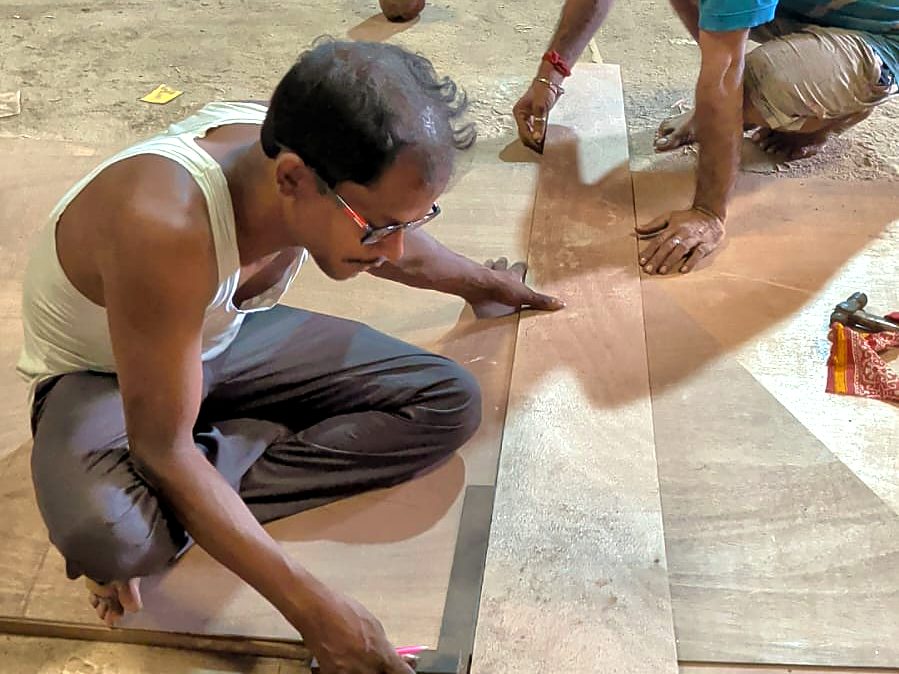
How we match grain at Kathwala
We lay out boards by hand before any cutting, so the grain flows across a tabletop and the stripes line up across a set of doors. Every piece of furniture and millwork we make is made to order, so we can choose boards for a particular look: flat-sawn for warmth, rift-sawn for calm modern lines, or quartersawn for fleck and stability. See architectural millwork and our full range.
Matching grain in design
- Book-match: two consecutive slices opened like a book, giving a mirror image. Classic for tabletops, cabinet doors and feature walls.
- Slip-match: consecutive slices laid side by side without flipping, so the pattern repeats. Calmer than book-matching and good for long runs of panelling.
- Random match: boards mixed for a natural, plank-by-plank look, as in solid-wood floors.
- End-match: slices matched top to bottom for tall panels.
- Grain direction: run the grain vertically on doors and tall cabinets, horizontally on long sideboards and low wall panels. Keep the direction consistent across a run of drawers.
- Mixing woods: pair a quiet grain with a bold one, for example maple with walnut, or rift oak with a single Zebrano feature panel.
For layouts and dimensions, see our guides to wall panelling ideas, main door designs and wooden ceiling designs.
Grain guide to every wood we stock
Each species page in our guide carries this profile in full. Click a name for density, hardness, stability, uses and stock sizes.
| Wood | Pores | Flat-sawn face | Quartersawn face | Figure to look for |
|---|---|---|---|---|
| White Oak | Ring-porous | Bold cathedral arches and flame shapes from the wide ring-porous earlywood bands, with long straight lines on either side. | Straight, parallel lines crossed by large silvery ray flecks, the “tiger” or “silver” figure; on white oak the flecks can be over 25 mm long. | Occasional curl, and burr oak in veneer; rift-sawn oak shows straight lines with almost no fleck. |
| Red Oak | Ring-porous | Strong cathedral arches like white oak, usually with a pinkish cast and a slightly busier pattern. | Straight stripes with ray flecks that are shorter and less dramatic than white oak’s. | Curly and birdseye red oak exist but are rare. |
| European Ash | Ring-porous | Bold cathedral arches with a high contrast between the porous earlywood and the denser latewood, much like oak but without the ray fleck. | Even, straight stripes; quiet and regular. | Some logs show dark brown streaks in the heartwood, sold as olive ash; curly ash is occasionally found. |
| White Ash | Ring-porous | Bold, regular cathedral arches and straight lines, high contrast between earlywood and latewood. | Straight, evenly spaced stripes. | Moderately curly boards turn up occasionally; most ash is plain and regular. |
| American Walnut | Semi-ring-porous | Soft cathedral arches and flowing lines in chocolate brown, with lighter and darker streaks running through. | Straight stripes, sometimes with a gentle wave. | Curl, crotch (feather) and burl figure are all found, and prized for veneers and tabletops. |
| American Cherry | Diffuse to semi-ring-porous | Gentle arches and flowing lines in pinkish to reddish brown, darkening richly with age. | Fine straight lines with a soft shimmer from the rays. | Curly cherry occurs; small dark gum flecks and pith flecks are common and are part of its character. |
| Teak | Ring- to semi-ring-porous | Flowing, slightly wavy lines and soft arches in golden brown, often with darker streaks. | Straight lines, sometimes broken by a mild interlock. | Plain to softly figured; mottled teak is occasional. |
| Burma Teak | Ring- to semi-ring-porous | Tight, even lines and soft arches; slow growth packs the growth rings closer than plantation teak. | Clean, straight vertical grain, which is why old-growth Burma teak is valued for decks and doors. | Darker streaks and an even honey-gold colour; occasionally mottled. |
| Indian Rosewood | Diffuse-porous | Flowing, irregular lines and dark purple-black streaks through golden to purple-brown heartwood. | Narrow, interlocked stripes with darker streaks; prized for guitar backs and veneers. | The near-black streaks are the figure; some boards are wavy. |
| Sapele | Diffuse-porous | Wavy, irregular lines; the flat-sawn face is plainer than the quartersawn. | The classic ribbon stripe: alternating light and dark bands that shimmer and swap as the light moves, caused by interlocked grain. | Pommele (blister-like spots), quilted, mottled, beeswing and fiddleback figure all occur. |
| Mahogany | Diffuse-porous | Soft, flowing lines and gentle arches in pinkish to reddish brown. | A clear ribbon stripe from interlocked grain, with strong chatoyancy (a 3D shimmer that moves with the light). | Crotch and mottle figure appear in some logs. |
| Iroko | Diffuse-porous | Broad, flowing lines in golden brown, sometimes irregular. | Interlocked grain gives a muted ribbon stripe. | Light-coloured mineral deposits (stone) can show as flecks. |
| Merbau | Diffuse-porous | Broad, coarse lines in orange-brown, darkening with age. | Straight to slightly interlocked stripes. | Small yellow mineral deposits show as specks in the pores, a merbau trademark. |
| Red Meranti | Diffuse-porous | Plain, straight to interlocked lines in reddish brown. | An attractive ribbon stripe from interlocked grain. | White resin (dammar) streaks can appear in the heartwood. |
| Malaysian Sal | Diffuse-porous | Fine, even lines with little contrast in yellowish to reddish brown. | A stripe figure on the quartersawn face from interlocked grain. | Small resin pockets occasionally. |
| Kapur | Diffuse-porous | Plain, even lines in reddish brown. | Straight to interlocked stripes; spiral grain occurs. | Mostly plain; kapur has a faint camphor smell when worked. |
| Padauk | Diffuse-porous | Straight to slightly wavy lines with visible open pores in bright orange-red. | Straight stripes, sometimes with a faint ribbon from interlock. | Mostly plain; the vivid colour mellows to a deep brownish red. |
| Purpleheart | Diffuse-porous | Plain, fairly straight lines with little arching; the colour does the talking. | Straight, even lines, sometimes with a mild ribbon. | Occasionally wavy or irregular; the purple deepens and then browns with age. |
| Sucupira | Diffuse-porous | Irregular, wavy, contrasting streaks of dark chocolate and lighter yellowish brown. | Interlocked stripes with a striking, irregular figure. | The light and dark streaks give it a lively, almost marbled look. |
| Zebrano | Diffuse-porous | Wide, irregular, wavy dark stripes on a golden ground. | Narrow, even, almost ruled zebra stripes; most zebrano is quartersawn or quarter-cut for this reason. | The stripes themselves are the figure; interlocked grain adds shimmer. |
| Wenge | Diffuse-porous | Bold, tightly packed dark lines on a chocolate background, giving a striped, almost graphic look. | Fine, straight, alternating light and dark bands like close pinstripes. | The light bands are parenchyma tissue, not growth rings, which is why the striping is so even. |
| Ebony | Diffuse-porous | Almost featureless jet black; the grain is barely visible. | Very fine straight lines that show only in raking light. | Occasional faint brown streaks; the deep, even black is the appeal. |
| Hard Maple | Diffuse-porous | Very fine, quiet lines and faint arches on a creamy background; often looks almost featureless. | Straight, faint stripes with tiny ray flecks. | The most figured of the pale woods: birdseye (small round “eyes”), curly or tiger stripes, and quilted figure. |
| Sycamore | Diffuse-porous | Pale, very fine and almost featureless, with soft faint arches. | Straight lines with a silky lustre and small ray flecks. | Famous for fiddleback (ripple) figure, the shimmering cross-stripes used for violin backs. |
| White Beech | Diffuse-porous | Plain and even, pale cream with fine straight lines. | Fine straight lines scattered with small, darker ray flecks. | Mostly plain; unsteamed beech can show a darker red heart in some boards. |
| Steamed Beech | Diffuse-porous | Plain and even, with fine straight lines and few arches; steaming evens the colour to a warm pinkish tan. | Fine straight lines scattered with small dark ray flecks, a beech signature. | Mostly plain; the ray flecks are the figure. |
| Thermo-Treated Beech | Diffuse-porous | The same quiet, even beech grain, now in a uniform coffee brown that runs right through the board. | Fine straight lines with the small ray flecks of beech, a little darker than the background. | Plain; the heat treatment changes the colour, not the grain. |
| Rubberwood | Diffuse-porous | Straight, plain lines on a pale cream to light tan ground. | Straight, even stripes. | Mostly plain, with little colour variation. |
| Gmelina (Gamari) | Diffuse-porous | Plain, straight to slightly interlocked lines on pale straw to yellow-brown. | Straight stripes with little contrast; growth rings show only where there is a dry season. | Mostly plain. |
| Douglas Fir | Softwood | Wild, bold cathedral arches with strong contrast between pale earlywood and dark orange latewood. | Straight, tightly spaced lines, sold as vertical-grain or “VG” fir. | Some boards are wavy; flat-sawn veneer can look busy. |
| Southern Yellow Pine (SYP) | Softwood | Very bold arches with high contrast: wide pale earlywood and sharp dark resinous latewood bands. | Straight, strongly striped lines. | The strong ring contrast is the figure; resin streaks are common. |
| Hemlock | Softwood | Straight lines and soft arches with only mild contrast between earlywood and latewood. | Straight, even stripes. | Plain; small black knots are typical. |
| Spruce | Softwood | Pale, fine, low-contrast lines and soft arches. | Fine, straight, even lines, which is why spruce is used for instrument tops. | Occasional “bear claw” figure on vertical-grain spruce. |
| SPF (Spruce-Pine-Fir) | Softwood | Pale white to light yellow with straight, low-contrast lines and soft arches. | Straight, even lines. | Plain; the knots are the main feature. |
How to buy wood by grain
- Name the cut. Write flat-sawn, rift-sawn or quartersawn on the drawing or order, not just the species.
- Check the end grain to confirm the cut before you accept boards.
- Ask for photos of the actual lot, wetted with mineral spirits or water to show the finished colour and figure.
- Specify the grade for knots and sapwood: clear, select or character.
- Keep boards from one log together for tabletops and panel sets, so colour and figure match.
- Allow for figure. Strongly figured wood costs more and needs careful machining and finishing.
Frequently asked questions
What is wood grain?
The arrangement and direction of the fibres and growth rings in wood, and the pattern they make on a cut surface.
What is the difference between grain and figure?
Grain describes fibre direction and ring spacing; figure is the decorative pattern you see, which comes from grain, texture, colour and the angle of the cut together.
Which cut of wood is most stable?
Quartersawn, followed by rift-sawn. Both move less in width and cup less than flat-sawn boards.
What is interlocked grain?
Grain whose direction alternates in successive layers of the tree. It makes the ribbon stripe of sapele and mahogany, and causes tear-out when planing.
Why does quartersawn oak have flecks?
Oak has very large rays running from the centre of the tree outwards. A quartersawn cut runs along the rays and exposes them as shiny flecks.
What does open grain mean?
Large, visible pores, as in oak, ash and wenge. Open-grained woods need a grain filler for a glossy finish.
Are knots a defect?
Tight, sound knots are a natural feature and are accepted in character grades. Loose knots can fall out and are usually cut out or filled.
Which woods have the most even grain?
Diffuse-porous woods with fine texture, such as maple, sycamore, beech and ebony.
Tell us the species, cut and look you are after. Everything we make is made to order. We respond within 24 hours.
Contact us on +91 98318 28922 (also on WhatsApp), +91 33 2259 1296 or info@kathwala.com.
Keep reading in Wood & Materials
- Indian Rosewood: The Price of a Tree That Takes a Century to GrowWhy Indian rosewood (Dalbergia latifolia) is so expensive: slow growth, scarcity, regulation and a wood that is hard…
- EU Green Claims Rules: What “Eco-Friendly” Wood and Furniture Can Still SayEmpCo, the EU’s green claims rules, has applied since 27 September 2026. What wood and furniture listings can…
- WPC Board: Price, Uses, and WPC vs PlywoodWhat WPC board is, where it beats plywood and where it doesn’t, typical prices, and how to work…
- Teak Wood vs Sheesham Wood: Price, Strength and LooksTeak vs sheesham: density, durability, stability, looks and price, and which to choose for doors, outdoor and indoor…
Sanjeev KhemkaWrites about timber, woodworking and trade for Kathwala, which supplies hardwood timber, plywood and panels and makes solid wood furniture and millwork to order. Questions? Get in touch.
Sources
- USDA Forest Products Laboratory, Wood Handbook: Wood as an Engineering Material (FPL-GTR-282), 2021
- Wiedenhoeft and Miller, Structure and Function of Wood (Wood Handbook chapter)
- Structure and physical properties of wood: appearance, grain, texture and figure (after the Wood Handbook)
- Fine Woodworking: Understanding figure in wood
- M. Bohlke Veneer: figure types
- The Wood Database: species grain and texture entries
- Queensland Government: meranti and kapur timber properties
- PROSEA: Shorea (balau) wood description
- Canada Wood: SPF species group